The AI Capex Squeeze: How GPU Spending Is Eating Enterprise IT Budgets
Corporate IT budgets barely grow year to year. So every dollar companies pour into scarce GPUs, AI servers and memory is a dollar pulled away from legacy software, licenses and mainframes. IBM's ~25% one-day crash is the clearest sign yet that the AI boom can hurt incumbent IT vendors before a model writes a single line of code.
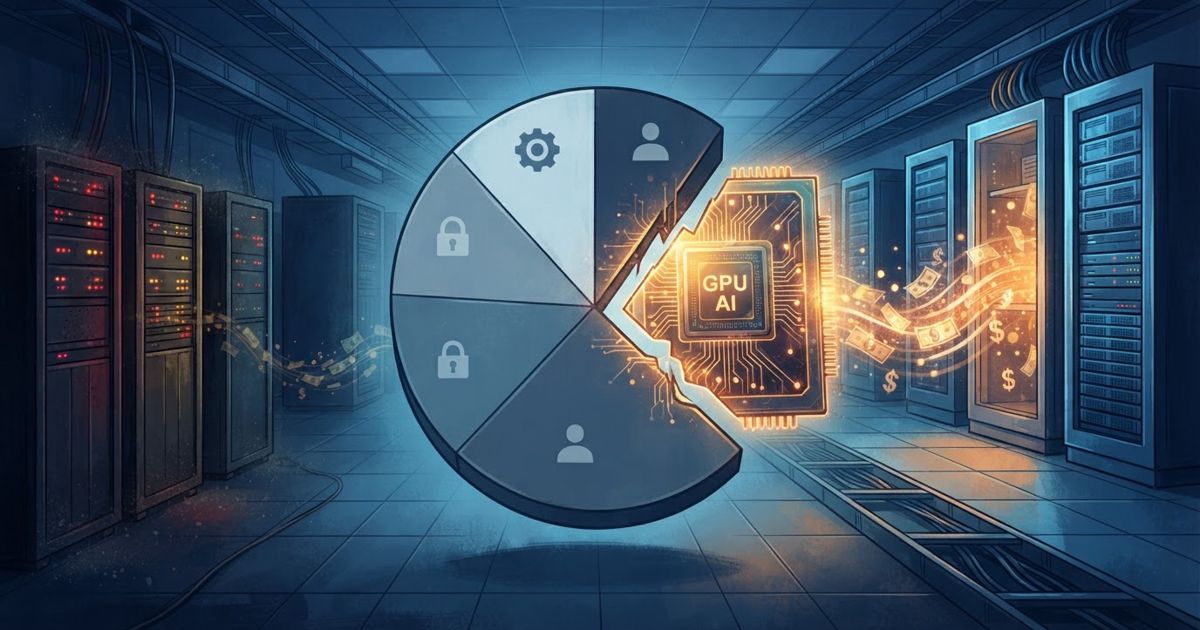
Table of contents
The most important number in enterprise technology this year is not a model benchmark or a token price. It is the size of the corporate IT budget — and the fact that, for most companies, it barely moves. Finance departments set an annual envelope, adjust it a few points for inflation and growth, and expect IT to live inside it. That envelope is the battleground where the AI boom is quietly turning into a zero-sum fight.
Here is the mechanism, stripped of the hype. When a Fortune 500 firm decides it must have GPUs, AI servers, high-bandwidth memory and the storage to feed them, that money does not fall from the sky. It comes out of the same fixed pool that used to buy database licenses, middleware renewals, consulting engagements and mainframe upgrades. Every dollar redirected to scarce, supply-constrained AI hardware is a dollar not spent with an incumbent software vendor. In other words, the AI boom can hurt the legacy enterprise-IT industry long before a single line of code is written by a model. The damage is done at the purchase-order stage, in the reshuffling of a budget that was never going to grow to accommodate both ambitions at once.
The IBM warning made the abstract concrete
For a long time this was a theoretical worry. On 14 July 2026 it became a very concrete one. IBM issued a rare preliminary warning that second-quarter revenue would rise only about 1% year over year, to roughly $17.2 billion — short of Wall Street's expectations. The market's reaction was brutal: the stock fell about 25% in a single session, its worst day in more than half a century, wiping out close to $70 billion in market value. Infrastructure revenue, home to the mainframe business, fell around 7%.
The explanation from CEO Arvind Krishna is the part worth dwelling on, because it is the thesis of this article stated by the company living it. In the final weeks of June, he said, clients rerouted their quarterly capital spending toward servers, storage and memory — racing to lock in supply-constrained hardware ahead of expected price increases — and a number of large software and consulting deals slipped as a result. Krishna was unusually candid about IBM's own role, telling investors the company "faltered and did not adapt and move quickly enough." The budgets did not shrink. They were simply spent somewhere else first.
Crucially, the sell-off did not stay contained. Shares of Microsoft, Salesforce, ServiceNow and Intuit fell in sympathy, because investors understood the read-through instantly: if IBM's customers are raiding the software budget to buy AI iron, so are everyone else's. The market repriced not one company's bad quarter but a structural risk to the entire enterprise-software category.
A second tax on the same wallet
There is a second, quieter dynamic pulling at the same budget, and it deserves sober mention rather than alarm. Cybersecurity spending is rising on its own trajectory, and one driver is the slow-motion migration to post-quantum encryption. Organizations that hold long-lived sensitive data increasingly assume a "harvest now, decrypt later" threat and are beginning to inventory and re-encrypt their systems ahead of quantum-capable adversaries. That work is unglamorous, mandatory for many regulated industries, and expensive — and it draws from the very same envelope now being emptied by GPU procurement. When AI hardware and security both demand more, something in the traditional software stack gets deferred. IBM's warning explicitly cited a client shift toward both AI infrastructure and cybersecurity.
Keeping the thesis honest
An analyst should resist the temptation to over-read a single quarter. IBM's stumble was partly self-inflicted; Krishna admitted as much, and a better-positioned vendor might have captured some of that AI spend rather than losing the software deal outright. Timing matters too — deals that slip out of June can close in September, converting a "crowding out" into a mere "pushing out." And some incumbents are genuine AI beneficiaries: the same customer buying GPUs may also be buying cloud, data platforms and security tooling from the survivors. The crowding-out effect is real, but it sorts winners from losers rather than sinking the whole sector.
Still, the direction of travel is hard to argue with. As long as AI hardware is scarce, expensive and treated as strategically urgent, it will win the internal competition for a budget that does not stretch. The vendors most exposed are those selling mature, discretionary, easily deferred software into buyers who now have a louder, hungrier priority.
The comforting narrative of the past two years was that AI would eventually threaten incumbent software by writing software itself. IBM's July warning suggests the near-term threat is more prosaic and arrives sooner. AI does not have to replace the enterprise-IT industry to hurt it. It only has to be first in line at the budget meeting.
Sources & further reading
Sources
- Bloomberg — IBM Shares Fall by Most Since 1960s After Sales Missed Expectations bloomberg.com
- CNBC — IBM warns second-quarter earnings fell short of expectations cnbc.com
- Data Center Knowledge — IBM Warns AI Infrastructure Spending Delays Software Deals as Shares Plunge datacenterknowledge.com
- Forbes — IBM Stock Loses ~$67 Billion: Causes And Recovery Outlook forbes.com